Showing posts with label md reviews books. Show all posts

Monday, March 14, 2016

Celebrating the Life of Albert Einstein in Books

Today is Albert Einstein's Birthday!

And.


We.
Are.
Excited.


Let's celebrate Einstein's contribution in the way librarians know best: in book form.

Picture Books

Odd Boy Out: Young Albert Einstein
By Don Brown


Like the title suggests, this picture book focuses on Einstein as an outcast, in his early years. This picture book is geared for readers ages 4-8. With some reading help from a guardian, this would be a good picture book to teach children about bullying, and isolation.

...

On a Beam of Light: A Story of Albert Einstein
By Jennifer Berne and Vladimir Radunsky


There is a truly unique art vision for this book. Paired with accessible text for young readers, this is a definitive Einstein picture book, sure to be enjoyed by a variety of readers.

...


Juvenile Books

Who was Albert Einstein?
By Jess Brallier


There is a reason why Who Was books are so popular with kids. Quirky illustrations paired with solid, interesting writing make these biographies great picks for kids interested in nonfiction, or kids who struggle to find books that interest them. Who Was Albert Einstein is no exception, and delivers in the series' great reputation.

...

Giants of Science: Albert Einstein
By Kathleen Krull


The Giants of Science series by Kathleen Krull is another solid choice for any kid looking for good nonfiction books. Her installment on Albert Einstein is aimed at kids grades 3-7.

...

Genius: A Photobiography of Einstein
By Marfe Fergusen Delano


If a child connects to narrative though images, this Einstein biography is a wonderful look into the visual world of Albert Einstein. Don't let the slim look of this book be deceiving: this photobiography is intended for grades 5-8.

...

Adult Nonfiction

Einstein: His Life and Universe
By Walter Isaacson


Isaacson is no stranger to covering tricky biography subjects. From his biography covering the life of Steve Jobs, to some of the most influential visionaries and innovators of our time, this thick Einstein brick is sure to satisfy all questions, while adding some of its own.

...

A Stubbornly Persistent Illusion: The Essential Scientific Works of Albert Einstein


Covers everything from Einstein's work on gravitational waves, to quantum theory. This book is geared towards the true Einstein devotee, who wants to more than biographical overview. The (rather hefty) volume is an appreciative look into Einstein's most important discoveries, with commentary from Stephen Hawking.

MD


Sunday, January 3, 2016

The Narrowing: How YA Lit Teaches Hard Lessons in Empathy, and Why We've Forgotten Them

We miss a train. It's annoying. Someone in front of us forgets to put their turning signal on. It's annoying. We oversleep our alarms. It's annoying AND troublesome, because now we need a different excuse besides, "Oh, it must have been my faulty apple update..."

For being well-seasoned adults, we truly have no patience. For anything. And I will not sit here as the holy exception. As for myself, my red hair practically flames when patrons gender their children's books and tastes.

Act 1: Scene 2
Youth Service Department

It is midday, and a LIBRARIAN appears to be attempting a lunch break, but a PATRON comes up to her desk. She appears slightly PALE from hunger. The PATRON tells the LIBRARIAN to reassure his daughter that comic books are for boys, and not girls.

LIBRARIAN: [calling forth the world's Zen]: Graphic novels are not just boy books, Mr. Jones.

PATRON: But comics are for boys.

LIBRARIAN: I see just as many boys taking out comics as girls. Good stories are for everyone.

PATRON: But when I was a kid...

LIBRARIAN tries to exit, wishes she was pursued by bear]


Extra patience would do us all well, but gaining empathy would perhaps work wonders. Going back to my example, more often than not, I find that patrons who believe that certain books are for either boys or girls often have this worldview shaped by their own upbringing, or their lack of a reading life. If they read, they would know that great stories truly are for everyone.

And when I get annoyed, or I am facing a difficult trial, I think of one group of people: teenagers.

And no, it's not what you are thinking. I do not find teenagers annoying. I think about them because they have to put up with the most annoyances (aka small and large life trials, depending on if you are asking Trump or Mother Teresa) than any other age group. And we often forget that time in our lives. I like young adult literature because a good young adult writer is still interested in how teenagers face those ugly growing pains. YA writers want to know how teens can empathize--often with each other-- to change difficult circumstance.

In looking back at my own life, I argue that when we are teenagers, we experience a critical change in empathy. Many older children are naturally empathetic, but it is often teenagers who are learning the hard lessons in empathy, or the difficult ways we must love in a difficult world. Well-written novels for adolescents represent that crossroad where young people must decide what they care about, and what their values are.

A well-written young adult book is not afraid to travel to the mind's caverns, especially the ugly ones that we adults would like to shrug off and forget, like an old coat.

The well-written young adult novel is prepared. It bears light and breadcrumbs into the dark woods.

Can this be said about many adult books? I'm not too sure, but perhaps the answer rests in the purpose of young adult literature: to build a---well, let's call it a "complicated sort-of of empathy."

Here are some examples.

One of my favorite young adult books, Tell the Wolves I'm Home, is told by a young adult protagonist who learns her uncle is dying from a disease her mother will not even name. This is infuriating to the narrator, as she is almost an adult.

In her sadness, the narrator describes the adult mind in this way:

"I really wondered why people were always doing what they didn't like doing. It seemed like life was a sort of narrowing tunnel. Right when you were born, the tunnel was huge. You could be anything. Then, like, the absolute second after you were born, the tunnel narrowed down to about half that size. You were a boy, and already it was certain you wouldn't be a mother and it was likely you wouldn't become a manicurist or a kindergarten teacher. Then you started to grow up and everything you did closed the tunnel in some more."

A narrowing tunnel. Probably not what we want to think our adult minds are like.

But more often than not we as adults will close off ourselves to new experiences, and block out past ones.

Take, for example, a look back at an old, high school classic.

The Catcher in the Rye protagonist, Holden Caulfield, is usually thought of as a cantankerous youth, a complainer, and an all-out-privileged whiner. Or as my friend put it, "I'd just really like to slap him."And he is annoying...for the most part. From another perspective, I remember many students in our high school English class pointing out that Holden was also a young person who is embarking on a very confusing, and difficult time in his life. Some students noted that the adults he was surrounded by either cared very little for him, or not at all. To top that off, a few students doubted the intentions of adults that were supposed to help Holden, even pointing out possible areas in which adults neglected and hurt him.

Were these our projections of our own pains at the time? Perhaps. But in a small English class, students were building empathy; albeit, a complicated type of it. Whether we thought Holden was a loser, or we felt pity for his character, we all had to listen to different opinions in our class on who Holden was, and where he was possibly going in his life.

Another young adult book that I remember that shaped my early adult life was The Curious Incident of the Dog in the Night Time. The novel follows a teenage boy, Christopher, as he tries to discover who could have possibly killed his neighbor's dog, which he found dead. What you learn from reading the book is that Christopher is different from many teens in that he is an individual who has autism. And this difference makes his story fascinating, his perspective eye-opening.

The way he sees the world often has an astute, intelligent humor:

“I like dogs. You always know what a dog is thinking. It has four moods. Happy, sad, cross and concentrating. Also, dogs are faithful and they do not tell lies because they cannot talk.” 

Christopher also has his own unique form of empathy, despite what people tell him. His autism is a part of his unique empathy. For example, here is what Christopher has to say about some of the day-to-day problems we all face:

“And when you look at the sky you know you are looking at stars which are hundreds and thousands of light-years away from you. And some of the stars don’t even exist anymore because their light has taken so long to get to us that they are already dead, or they have exploded and collapsed into red dwarfs. And that makes you seem very small, and if you have difficult things in you life it is nice to think that they are what is called negligible, which means they are so small you don’t have to take them into account when you are calculating something.” 

Well-written young adult literature brings to light a unique form of empathy that I think we all need to search for again, but as an adult. Sensitivity to other people and their differences may be harder when we enter adulthood, but seeing how other people live and think is a necessary way to help improve our own lives, and the lives of other people.

Young adult literature is an excellent portal back into that place of empathy, but the 2.0 version. This empathy enters the gnarlier incarnation of our daily lives; lives which are now composed of never getting enough sleep, the laundry never being done, and work always piling up, annoying as ever.

But this is a life where I hope we can come to our own understanding of empathy. The best young adult books not only encourage us to form empathy in complicated situations. These books also seem to have one common hope for the young adult, as they enter adulthood. And perhaps, this message is more applicable to us, as adults.

It's quite simple, really:

May our minds never narrow.

MD

Saturday, December 5, 2015

Goodreads Choice Awards 2015--MD's Favorite Finalists

Every year I look forward to the goodreads choice awards. For those of you who don't know, goodreads is a website where you can keep track of books you have read, and you can recommend books to your friends.* Although my favorite picture book of the year (and my favorite chapter book of the year) were not chosen as the final winners, my favorites did make it into the top ten. So, here are my favorite children's books of 2015.

Picture Books

Red: A Crayon's Story, by Micheal Hall


Red: A Crayon's Story is the tale of a crayon that is labeled "red" but is in fact blue. This difference causes some problems when red crayon is needed to draw some red things, like ripe summer strawberries. But as you can guess...they come out blue.


Below, red crayon tries to make a red ant. But alas! It comes out as a blue ant. 


I like this story because it has very creative, and charming illustrations. It also contains a well-written narrative. I think many people, big and small, can relate to red crayon's struggle, as he may be labeled as one thing by everyone else, but deep inside he is something different. Like red crayon, we all need help to learn how to accept and love unique parts of ourselves. 

Juvenile Book 

The Marvels, written & illustrated by Brian Selznick


There are few books as trail-blazing and unique as Brian Selznick's The Marvels. The first part of the book is composed of hundreds of breath-taking illustrations, which tell the story of several generations in the Marvel family. 

Here, have a look-see:


After these illustrations, begins the story of a boy in the 1990's, as he runs away from school to look for his uncle. This young boy, Joseph Jervis, learns about his family history---and perhaps, even more about himself. At his uncle's strange and glorious home, clues unfold as to where Joseph's family has come from, and perhaps, the avenues in which Joseph can escape his stifling life. 

And yes, without revealing any more of the plot, this book was incredibly moving. One that I am glad to hear several other youth-lit aficionados got teary-eyed over.**


So, those were my top goodreads picks. As I said, they did not win the goodreads choice awards for 2015, but that's okay. 

After all, that's what librarians do: we spread the books. 

MD

*Goodreads: Think Facebook meets your own personal library, but with no wedding photos, or uncle Bill's political opinions.

**Let's be honest with ourselves, we sobbed and there's no denying it.

Friday, June 19, 2015

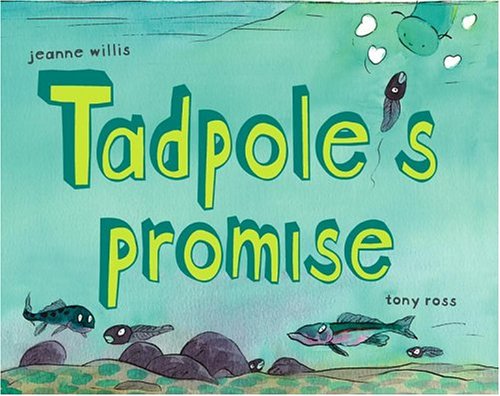
Tadpole's Promise

MD's Saturday book reviews, given in-between trips to settle mischief-making in the back of the youth section of the library.


Today isn't a Saturday, but I've had to settle mischief in the back of the library several times today. In any case, this book review comes a day early because Saturday will be another busy day in Youth Services.

Today's book is a picture book titled:


The story book begins with caterpillar meeting tadpole. Caterpillar is immediately enamored with tadpole and tells him she loves everything about him, and that he should never, ever change. 


"I love everything about you," said the caterpillar. "Promise you will never change."
"I promise," he said.

You may think you may know where this story is headed. The story revolves around a caterpillar and a butterfly, after all. But as the tadpole grows into a frog, and as the caterpillar transforms into a butterfly, what happens is perhaps a little more sinister, a little more true to real life. 


"Yes, but you are not my shiny black pearl. Goodbye."


Enveloping the dark humor of current, classic picture books, such as I Want My Hat Back, the story Tadpole's Promise is a good look into a world that we all know is not always quite fair, or quite just in its workings. Written by British author Jeanne Willis, and illustrated by the very talented Tony Ross, this is quite a funny, serious, and definitely memorable cautionary tale.


"Excuse me," she said. "Have you seen my shiny black..."


Have a great weekend, MD

Saturday, June 13, 2015

Drum Dream Girl

MD's Saturday book reviews, given in-between trips to settle mischief-making in the back of the youth section of the library.

It's a quieter day at the library today, so let's see if I can squeeze in a review before closing. 
This week I found a great book thanks to Theresa, called Drum Dream Girl . Written by Cuban-American writer Margarita Engle, Drum Dream Girl  tells the true story of Millo Castro Zaldarriaga, the first well-known female drum player in Cuba.

The story begins in 1930's. Believe it or not, at the time it was taboo for girls to play the drums in Millo's home country, Cuba.This does not stop Millo, however. She dreams of one day playing the drums in a cafe band, but she is met by the scorn of her father and town.


With the aid of a teacher, Millo finally gains the instruction she needs. And that, as they say, is history. Now ready to perform, Millo creates an awesome, all-female band. 


Illustrated by Rafael Lopez, Drum Dream Girl is an unforgettable mix of cultural narrative, and the universal need to dream. I would recommend Drum Dream Girl for ages 6-106. It is especially wonderful for young women in their search---that remains to this day---for equality to live and dream.

MD

Saturday, June 6, 2015

Chu's Day at the Beach

MD's Saturday book reviews, given in-between trips to settle mischief-making in the back of the youth section of the library.

Neil Gaiman has undoubtedly been a favorite author of mine. Since I first opened up his classic scary tale for children, Coraline, I was quite in love with the fact that someone had articulated so well childhood fears, loneliness, and the sometimes neglectful world of adults. (Also, those creepy buttons for eyes!) I am quite fortunate, in pondering this over, to have a favorite author who writes such a variety of books for all-ages.

Neil Gaiman's "Chu" series is a collection of picture books about---as the title would suggest---a panda named Chu. The panda has the unfortunate quality of sneezing, and sneezing quite often. This would not be a problem if his sneezes were not powerful enough to destroy everything in their path, which they are.


The accompanying, richly-illustrated art by Adam Rex is simply gorgeous.


And it perfectly matches Gaiman's sometimes droll wit.


 And as you have seen, there are merpandas.

That is all,

MD