Sunday, January 24, 2016

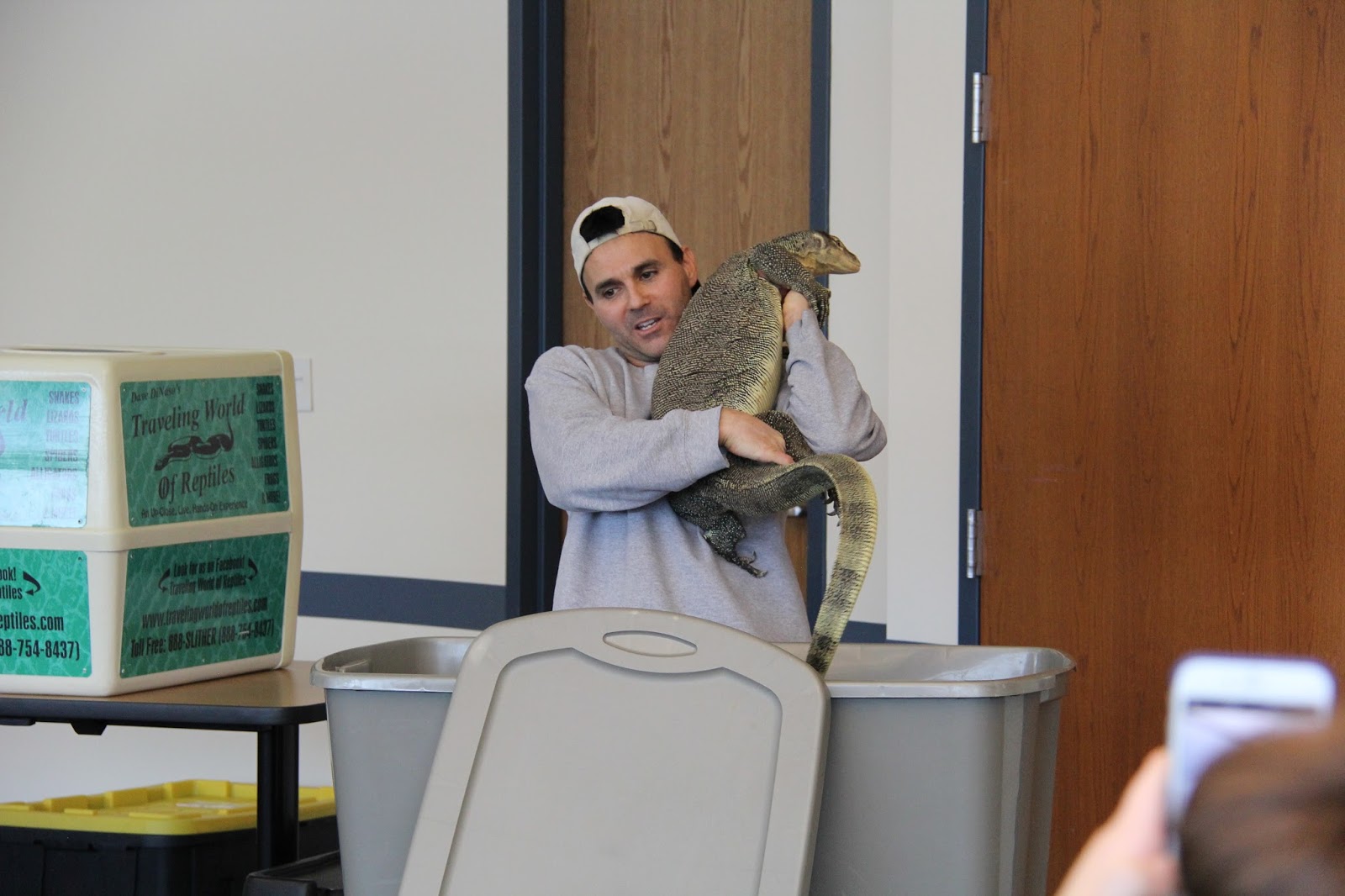
Dave DiNaso's Traveling World of Reptiles

This Saturday we had Dave DiNasso stop by for his unforgettable Traveling World of Reptiles. This has got to by my favorite event to photograph, by far. Enjoy!

MD


^Brave Soul Award goes to...


Sunday, January 17, 2016

Not To Tempt You, But...

Here are some of our winter reading prizes.

Also, please send help. I am addicted to the squishy brain prize.


California Pizza Kitchen gave us some free kids meals. Oberweis in Elmhurst gave free ice cream!


Oh, and this year we have marble sets that include instructions on how to play the game.

There are loads of other prizes, too. This is just all I can handle right now because the squishy brains are taking up 97.2% of my attention. 

Maybe later I can post more, 

MD

Thursday, January 14, 2016

Winter Reading

Our Blizzard is Brewing! 


We have already had a great start to winter reading! Don't forget to sign up to read and earn fantastic prizes! 


Wednesday, January 13, 2016

DIY: Make Your Own Soap (With Creature Inside!)

Here is what we used:

Supplies 
1. Glycerin blocks (unscented)
2. Microwave safe measuring cups
3. Skin-safe coloring
4. Skin-safe scents (in droppers)
5. Plastic mold trays
6. Vaseline 
7. Alcohol (in spray bottle)
8. Small plastic toys (to fit in mold)
9. Patience
10. More Patience

How to make your own soap.

1. Cut Glycerin Blocks into Cubes: Glycerin comes in large blocks. You want to cut your blocks into small pieces, like cheese cubes. We had 18 participants, and used two large blocks of glycerin. (Each block at 2 lbs each.)

2. Grease Plastic Mold: Take the plastic mold you will pour your liquidized glycerin in, and coat the inside of the mold with a thin layer of Vaseline. This will prevent the hot glycerin from clinging to the walls of the plastic mold. 

3. Melt Glycerin in Microwave: Melt glycerin in microwave safe measuring cups. Melting time will depend on the amount of glycerin blocks/microwave wattage. Your best bet for effectively melting the blocks (without overheating) is setting the microwave for a minute, and watching the blocks crumple, and melt. Once the blocks are liquidized, wait a few seconds. Then press STOP. 

Do not allow the glycerin to boil. 

4. Choose Scent, Color. and Animal for Soap: While the glycerin heats, students should choose a scent, color, and small plastic toy to go inside their soap bar.

5. Pour Glycerin into Soap Mold: Pour liquid glycerin into mold. Work quickly to incorporate about ten drops of the skin-safe scent, and 2-4 drops of skin-safe color. Stir in mold.


6. Place plastic toy in soap: Wait until film develops on the top of soap. Spray the plastic toy that will go inside the soap with alcohol, to eliminate air bubbles that can form around it. When a firm but thin film develops, use a plastic knife to push film aside, and insert toy into soap, and under the film. 

7. Finishing Touches: Spray top of soap (lightly) with alcohol to eliminate air bubbles. Alcohol can also be sprayed between multiple colors of glycerin, for a layered soap.

8. Drying: Allow glycerin to dry, and do leave mold to rest for several hours. The hardening process can be sped up by refrigeration.

MD

Note: 1. The best way to know how much glycerin to melt is to get a measurement of how much liquid your soap molds can hold. Pour water to fill your soap mold,, and then transfer that water to a measuring cup. This will give you an idea of how many glycerin cubes you must melt. 
2. Liquid glycerin solidifies quickly. Work fast!

Makerspaces: Giving Our Libraries Some STEAM

The latest issue of a library journal, Library Sparks, discussed an upcoming trend in libraries, called "Makerspaces." Makerspaces originated out of campaigns to get kids involved in STEAM activities, or hands-on learning experiences involving Science Technology Engineering Art or Math.

Long before Makerspaces evolved to Makerspaces TM, having my own space where I could build and engage in active learning was in important part of my life. I remember television shows like PSB Zoom! that encouraged kids to enjoy simply creating things. Shows like Zoom! were not only fun to watch, but their ideas validated my way of learning.

I needed space for learning, as much as I needed my learning to be hands on.


Zoe, my favorite Zoomer.


Flash forward a couple years at school, and the message we students were receiving was not the same. We were told only a few kids could do a science experiments because of limited supplies. Our grade school labs could only have one trial experiment because of time limits. In high school, we were graded based off experiments where we had only one shot to get it right.

And last time I checked, having one trial shot to learn anything is not the way to learn.

my feels, depicted via Bill Nye The Science Guy

We know schools are underfunded. So are libraries. But we, as librarians, have a unique opportunity to take the initiative to create amazing programs that promote STEAM. We can try and pick up where schools, finances, common core, and administration have failed.

So here is my guide to trying to work within your library system to make some great programs for your kids. Most involve creativity, and not a lot of cash.

Makerspace STEAM Programs: (The Way-Way Under Budget Edition)

Ask About Grants

If you don't have the money, and are riding with the $0 policy, look into grants. All districts and states are different, but the time you spend applying for grants will be worth it. If it is a specific librarian's job to work on grants, work with them, and say what you wish the library would have for your maker's programs. Create plans with specific, reasonable ideas. Bounce these ideas off other librarians. Make the grant hunt a collaborative process which includes input from your director, and coworkers. 

Remind them: the money you receive from a grant could never be made via fundraising. The hours you put into the grant hunt will pay for itself.

Fundraisers

Can your community collect used books to sell at a library book sale? Can you have a restaurant day where a portion of the proceeds go to your library? Can you find people who want to auction off goods in your lobby display cases? Can you find local businesses who want to sponsor your program?

Get creative. Good things come to those who ask. 

...


So, now that you've got a bit of money, here are some low budget programs we did here at the Oak Brook Public Library. All of these programs drew a high-occupancy, and were favorites from our students. 


Program One: Lego League, by Miss Stephanie (Cost: Lego's and Creativity)

Miss Stephanie from youth services made it a priority to get our patrons in youth services some legos. She then crafted a building program around STEM learning, for some great lego fun. The following images are hers, taken from the first meeting of the Lego League:


Program Two: Coding (Cost: Team Up with a Local Code School...for free?)

Did you know many grade schools and high schools are now teaching their kids and young adults to code? Well, they are. Code is the language of computers, and it creates everything you see on your computer screen. Building websites is an integral skill needed for the future. We were lucky enough in the past to team up with coding educators. Find a local chapter of a coding school, and you may be in luck for a free program demo in teaching your kids to code!


MD Maker's Workshops with Miss Theresa

Oh, Miss Theresa and I have done many a Maker's Workshop. Here are some projects with STEAM backgrounds that we have enjoyed with our patrons.

Program Three: Bring in a Wildlife Buddy (Cost: Nature Center Fee, or Free?)


I happen to have an African Pygmy Hedgehog as a pet. His name is John Watson. He has been able to stop by for many programs, some of them teaching about hedgehogs, and their life in the wild.

Programs with animals are worth having. Conservation and education are important aspects of scientific thinking. If you are looking to have a program with animals for some zoological fun, look into getting a local chapter of a nature center come by. Chances are, they want to have an established relationship with the community, and would love to do a program. 

Program Four: Make Your Own Soap (Under $50)


This weekend Theresa and I had the task of trying out a new program. Of course, it takes time to fine-tune a project, but all of the rushing around was worth it. We had around 18 students in a class learning to make their own soap. And they had many questions!

How do you make soap?
Why do glycerin blocks melt?
Why does soap get bubbles when you add water to it?
How long does it take for liquid soap to harden into a bar of soap?

It was exciting to try and answer these questions. By making soap, it sparked student's curiosity in more complex topics.

If this project sounds like something you would like to see at your library, look for a future post on how-to make your own soap.

...
In closing, one of the things I liked about the Library Sparks articles on Makerspaces was that the authors pointed out that any materials and programs targeted at "STEAM learning" are going to be expensive, especially if you hire out. The answer for many libraries seems to be a process of creativity, and not giving up when you have set goals. 

You may not have a professionally made Makerspace, or maker's supplies, but a little bit of creativity can go a long way in integrating STEAM programming into your library.

MD

Wednesday, January 6, 2016

Happy Birthday, Mr. Holmes

About a year ago, I was lucky enough to make the pilgrimage some Sherlock Holmes fans are lucky enough to make. With the aid of my friend in Amsterdam, we traveled to see Holmes' famous stomping grounds, in the city of London.


London, even in the beginning of January, was thrumming with life. One thing photographs cannot capture is how foggy the city can get, how dark and atmospheric it can feel. So it fit my favorite fictional character, Sherlock Holmes. The city lived up to every myth and legend. I could imagine thousands of different lives being lived out, all in one city.


Of course Sherlock Holmes was never a real person. Nor was the address 221 B Baker Street. (Until the Sherlock Holmes society resurrected a fictionalized museum-home for the great detective in the early nineties.) Despite Holmes never having been in London, his presence is felt more than ever. The Baker Street tube stop bears his image; there are signs, books, and statues in his honor. 


In the 221 B Baker Street museum, you can find an entryway with coats hanging on hooks; one for Watson, one for Holmes. In the main guest parlor, a brass oil lamp burns. On a desk are correspondences addressed to Holmes. A foot stool holds his violin, which rests atop a messy array of sheet music.


The museum was gorgeous, if not a touch eerie. It felt like you walked into someone's home when they were gone. It felt almost personal to poke around at the objects, or to put on Holmes' deerstalker. 

It felt like he'd be walking through the door any moment, bandit at his heels. 

Despite the surreal experience of knowing what I was seeing wasn't a real person's home, it did make me think about the character of Holmes, himself. In the line waiting to see the museum, I was surrounded by people from all over the world: China, France, all stretches of Europe. Holmes' character has reached far beyond London, and has taken on a worldly incarnations. 

I always wonder what draws people to the character of Sherlock Holmes. All I can say is I remember what drew me in. It was a few lines from the original stories.

Watson is hurt, and Holmes addresses him, asking, "You're not hurt, Watson? For God's sake, say that you are not hurt!"

Watson is shocked that Holmes is concerned about him, as it goes against his usual, cold manner. 

In a revelation to his character, he discovers that Holmes was more human, more suspect to the emotions we all feel than he let on. Watson thinks, "It was worth a wound -- it was worth many wounds -- to know the depth of loyalty and love which lay behind that cold mask."

In going to London, I got a glimpse behind that mask. Special thanks to my friend for taking the journey with me, knowing tube stops like the back of her hand, and making it possible to see Holmes' world. And of course: Happy Birthday, Mr. Holmes.

You don't look a day over 162. 

MD

Photography by me, MD. All museum photographs were taken with permission from 221 B Sherlock Holmes museum. 

Sunday, January 3, 2016

The Narrowing: How YA Lit Teaches Hard Lessons in Empathy, and Why We've Forgotten Them

We miss a train. It's annoying. Someone in front of us forgets to put their turning signal on. It's annoying. We oversleep our alarms. It's annoying AND troublesome, because now we need a different excuse besides, "Oh, it must have been my faulty apple update..."

For being well-seasoned adults, we truly have no patience. For anything. And I will not sit here as the holy exception. As for myself, my red hair practically flames when patrons gender their children's books and tastes.

Act 1: Scene 2
Youth Service Department

It is midday, and a LIBRARIAN appears to be attempting a lunch break, but a PATRON comes up to her desk. She appears slightly PALE from hunger. The PATRON tells the LIBRARIAN to reassure his daughter that comic books are for boys, and not girls.

LIBRARIAN: [calling forth the world's Zen]: Graphic novels are not just boy books, Mr. Jones.

PATRON: But comics are for boys.

LIBRARIAN: I see just as many boys taking out comics as girls. Good stories are for everyone.

PATRON: But when I was a kid...

[ LIBRARIAN tries to exit, wishes she was pursued by bear]


Extra patience would do us all well, but gaining empathy would perhaps work wonders. Going back to my example, more often than not, I find that patrons who believe that certain books are for either boys or girls often have this worldview shaped by their own upbringing, or their lack of a reading life. If they read, they would know that great stories truly are for everyone.

And when I get annoyed, or I am facing a difficult trial, I think of one group of people: teenagers.

And no, it's not what you are thinking. I do not find teenagers annoying. I think about them because they have to put up with the most annoyances (aka small and large life trials, depending on if you are asking Trump or Mother Teresa) than any other age group. And we often forget that time in our lives. I like young adult literature because a good young adult writer is still interested in how teenagers face those ugly growing pains. YA writers want to know how teens can empathize--often with each other-- to change difficult circumstance.

In looking back at my own life, I argue that when we are teenagers, we experience a critical change in empathy. Many older children are naturally empathetic, but it is often teenagers who are learning the hard lessons in empathy, or the difficult ways we must love in a difficult world. Well-written novels for adolescents represent that crossroad where young people must decide what they care about, and what their values are.

A well-written young adult book is not afraid to travel to the mind's caverns, especially the ugly ones that we adults would like to shrug off and forget, like an old coat.

The well-written young adult novel is prepared. It bears light and breadcrumbs into the dark woods.

Can this be said about many adult books? I'm not too sure, but perhaps the answer rests in the purpose of young adult literature: to build a---well, let's call it a "complicated sort-of of empathy."

Here are some examples.

One of my favorite young adult books, Tell the Wolves I'm Home, is told by a young adult protagonist who learns her uncle is dying from a disease her mother will not even name. This is infuriating to the narrator, as she is almost an adult.

In her sadness, the narrator describes the adult mind in this way:

"I really wondered why people were always doing what they didn't like doing. It seemed like life was a sort of narrowing tunnel. Right when you were born, the tunnel was huge. You could be anything. Then, like, the absolute second after you were born, the tunnel narrowed down to about half that size. You were a boy, and already it was certain you wouldn't be a mother and it was likely you wouldn't become a manicurist or a kindergarten teacher. Then you started to grow up and everything you did closed the tunnel in some more."

A narrowing tunnel. Probably not what we want to think our adult minds are like.

But more often than not we as adults will close off ourselves to new experiences, and block out past ones.

Take, for example, a look back at an old, high school classic.

The Catcher in the Rye protagonist, Holden Caulfield, is usually thought of as a cantankerous youth, a complainer, and an all-out-privileged whiner. Or as my friend put it, "I'd just really like to slap him."And he is annoying...for the most part. From another perspective, I remember many students in our high school English class pointing out that Holden was also a young person who is embarking on a very confusing, and difficult time in his life. Some students noted that the adults he was surrounded by either cared very little for him, or not at all. To top that off, a few students doubted the intentions of adults that were supposed to help Holden, even pointing out possible areas in which adults neglected and hurt him.

Were these our projections of our own pains at the time? Perhaps. But in a small English class, students were building empathy; albeit, a complicated type of it. Whether we thought Holden was a loser, or we felt pity for his character, we all had to listen to different opinions in our class on who Holden was, and where he was possibly going in his life.

Another young adult book that I remember that shaped my early adult life was The Curious Incident of the Dog in the Night Time. The novel follows a teenage boy, Christopher, as he tries to discover who could have possibly killed his neighbor's dog, which he found dead. What you learn from reading the book is that Christopher is different from many teens in that he is an individual who has autism. And this difference makes his story fascinating, his perspective eye-opening.

The way he sees the world often has an astute, intelligent humor:

“I like dogs. You always know what a dog is thinking. It has four moods. Happy, sad, cross and concentrating. Also, dogs are faithful and they do not tell lies because they cannot talk.” 

Christopher also has his own unique form of empathy, despite what people tell him. His autism is a part of his unique empathy. For example, here is what Christopher has to say about some of the day-to-day problems we all face:

“And when you look at the sky you know you are looking at stars which are hundreds and thousands of light-years away from you. And some of the stars don’t even exist anymore because their light has taken so long to get to us that they are already dead, or they have exploded and collapsed into red dwarfs. And that makes you seem very small, and if you have difficult things in you life it is nice to think that they are what is called negligible, which means they are so small you don’t have to take them into account when you are calculating something.” 

Well-written young adult literature brings to light a unique form of empathy that I think we all need to search for again, but as an adult. Sensitivity to other people and their differences may be harder when we enter adulthood, but seeing how other people live and think is a necessary way to help improve our own lives, and the lives of other people.

Young adult literature is an excellent portal back into that place of empathy, but the 2.0 version. This empathy enters the gnarlier incarnation of our daily lives; lives which are now composed of never getting enough sleep, the laundry never being done, and work always piling up, annoying as ever.

But this is a life where I hope we can come to our own understanding of empathy. The best young adult books not only encourage us to form empathy in complicated situations. These books also seem to have one common hope for the young adult, as they enter adulthood. And perhaps, this message is more applicable to us, as adults.

It's quite simple, really:

May our minds never narrow.

MD

Thursday, December 17, 2015

Lego League Launch!

Lego League

Our First Lego League is a Success!
Tuesday evening we hosted our first Lego League with great success. Our participants spent the hour building, creating, and collaborating with peers. Many were excited to find that OBPL has various books available on Lego creations that they could check out for their own use.

The December theme was: Transportation
We had a lot of fun and ended with creations of all kinds. 


Be sure to sign up today for our January Lego League! 
January 14th at 6:30-7:30 pm, ages 4 & up.
Registration is Required!


Posted by Miss Stephanie